My First 100km: What Running with Dean Karnazes Taught Me

There are moments in life where you don’t fully understand what you’re stepping into. You know it’s big. You know it matters. But the meaning only really reveals itself later, often quietly, long after the finish line is crossed.
The Blackall 100 was one of those moments for me.
Held each October in the hinterlands of Queensland’s Sunshine Coast, the Blackall 100 is a brutal, beautiful 100km ultra marathon. Steep climbs, dense bush, long hours of solitude and just enough technical trail to keep you honest. My first attempt was in 2019 — a year that already carried more weight than most.
My marriage had ended the year before. Like many men navigating that kind of loss, uncertainty and identity shift, I needed somewhere for the energy to go. Trail running became my outlet. Especially solo night runs in the bush. They were confronting, uncomfortable and a little rebellious — but they were also grounding. There’s something about being alone in the dark, moving forward under your own power, that strips life back to what matters.
By the time Blackall rolled around, I’d run most sections of the course individually. I knew the climbs. I knew the descents. What I didn’t know was what it would feel like to stitch all of those pieces together into one continuous effort.
2019 was also a big year for the event for another reason — Dean Karnazes was coming.
For anyone involved in endurance sport, Dean needs little introduction. Ultramarathon Man wasn’t just a book about running; it redefined what people believed was possible. His story of rediscovering purpose through running in his 30s resonated deeply with men and women questioning what life was supposed to look like next.
So when Dean arrived in Australia, via Greece, around 250 people packed into a room mid‑week to hear him speak. He shared stories, lessons, mistakes, and the reality behind the feats. What stood out wasn’t bravado — it was humility. A quiet confidence built on work, not words.
Dean arrived sick. Properly sick. Long‑haul flights will do that. He had to leave the stage more than once to hit the bathroom. When it came time for book signings and selfies, I stayed back. It felt like the right thing to do.
A few days later, we stood on the start line of the Blackall 100.
The atmosphere was thick — spectators, runners, nervous energy. Dean had an entourage early. Throughout the day I crossed paths with him a few times. Each time, the group around him was smaller.
Let me be clear: I am not an elite runner. Not even a great runner. Dean was unwell. Any normal human would’ve stayed in bed. Instead, he was jogging his way through 100km of brutal terrain.
That alone told you everything you needed to know.
The Blackall 100 is a Western States Endurance Run qualifier. To qualify, you need to finish under 18 hours. Late in the race, I arrived at the final checkpoint in the dark. Dean was there with the race director, his sponsors and a medic. He’d fallen a few times and was being patched up.
Despite everything, he was determined to continue.
I refilled my hydration, grabbed some food and prepared to leave. That’s when the race director asked if I’d be willing to run the final 8km with Dean — tight, winding singletrack through dense bush — just to make sure he was okay.
I walked about 30 metres up the trail and turned off my headlamp.
Standing there under the moonlight, I felt the full weight of how surreal the situation was. I thought about why I’d found myself in ultras at all. About the way Dean’s book had landed for me during a time when life felt fractured. About purpose. About challenge. About choosing to keep moving forward.
As Dean shuffled up the trail, I asked if he wanted company for the final section.
He was deeply appreciative.
We moved together — slowly, steadily. I asked a few questions and mostly listened. He spoke about Australia, about having once been an exchange student in Sydney. About the strange realities of fame through running. About the places and people he’d encountered along the way.
What struck me most was that he was exactly the same man I’d heard speak days earlier — no performance, no ego. Just presence.
I’d been introduced to ultra running by my neighbour Andy, a doctor and exceptional long‑distance runner. He saw what I was carrying after my marriage ended — the uncertainty, the self‑blame, the distance from my kids — and simply told me I was going for a run.
We ran through bush, tunnels, brutal climbs. Eventually we reached a lookout over the hinterland stretching to the ocean. That run changed something. Andy and I sat together listening to Dean speak that Wednesday night, both understanding why his story mattered.
Dean didn’t invent endurance. He didn’t corner the market on suffering or resilience. But he did something powerful — he gave people permission to believe they were capable of more. Through humility, hard work and showing up when it was hardest, not just when it looked impressive.
That influence ripples outward.
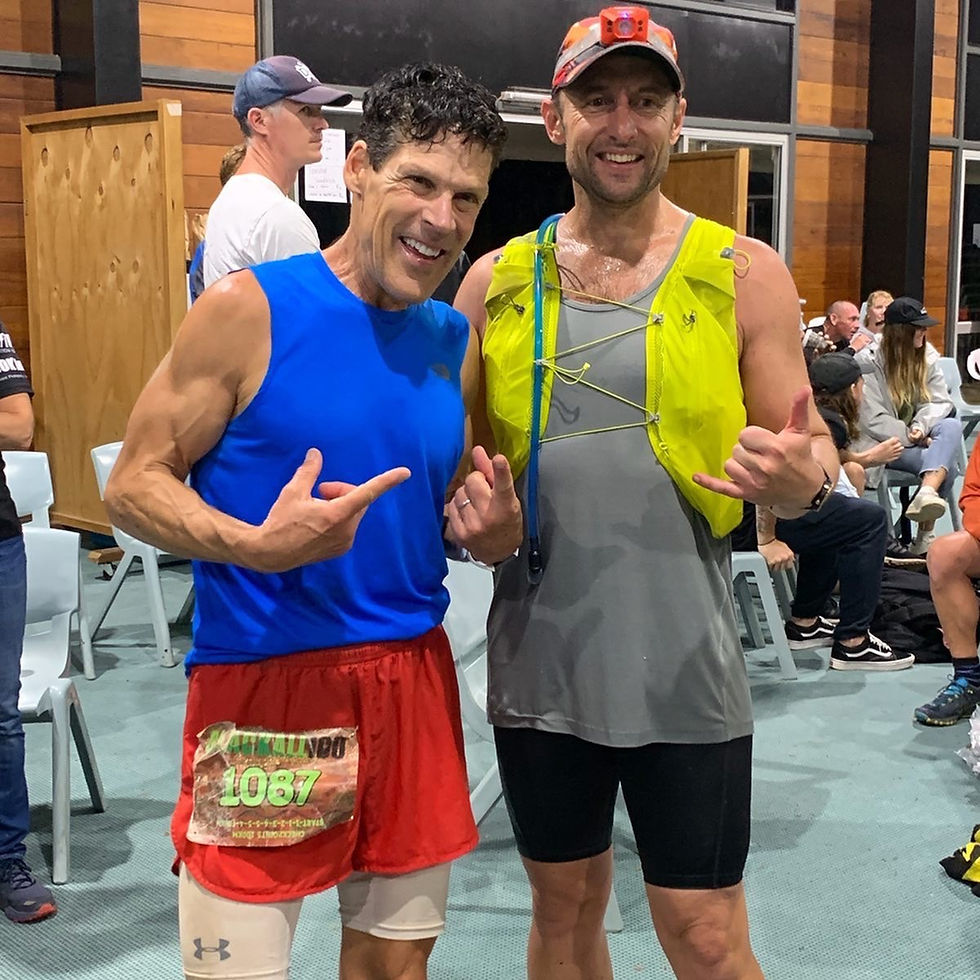
My eldest son watched this story unfold. His dad finishing his first 100km race alongside the Ultramarathon Man himself — who insisted on holding my hand as we crossed the line and rang the finish bell together.
That moment was a gift.
Not because of the distance or the name attached to it — but because of what it demonstrated. That real strength is quiet. That leadership is lived. And that when someone shows what’s possible through action, not words, it can change the trajectory of those watching.
That’s what the Blackall 100 gave me.
And that’s the lasting power of a tremendous human choosing to live their values when it counts.
And for my son Baylin.... well check out what he did when he got the chance, The First S.M.U.T.I.


Comments